User's guide
Notes
Any writing longer than a line can become a note, a page with a title that you can come back to, edit, and find again. Notes is the tab that holds all of them, and every long entry you titled in the Journal is already one.
Where they come fromTwo ways to start one, and they make the same thing
Choose Write a note under the + in the Journal and give it a title, and it becomes a note with a card on your timeline at the moment you wrote it. Tap that card to open the whole thing.
Or start one directly. Notes has a plus, beside the heading on the web and at the foot of the screen on the phone, and it makes a note and opens it. The new note arrives unnamed with its title field waiting, so you name it on the note rather than before it exists.
Both routes make the same object. A note started from the Journal keeps its place in the day, and one started from the Notes tab is simply a page.
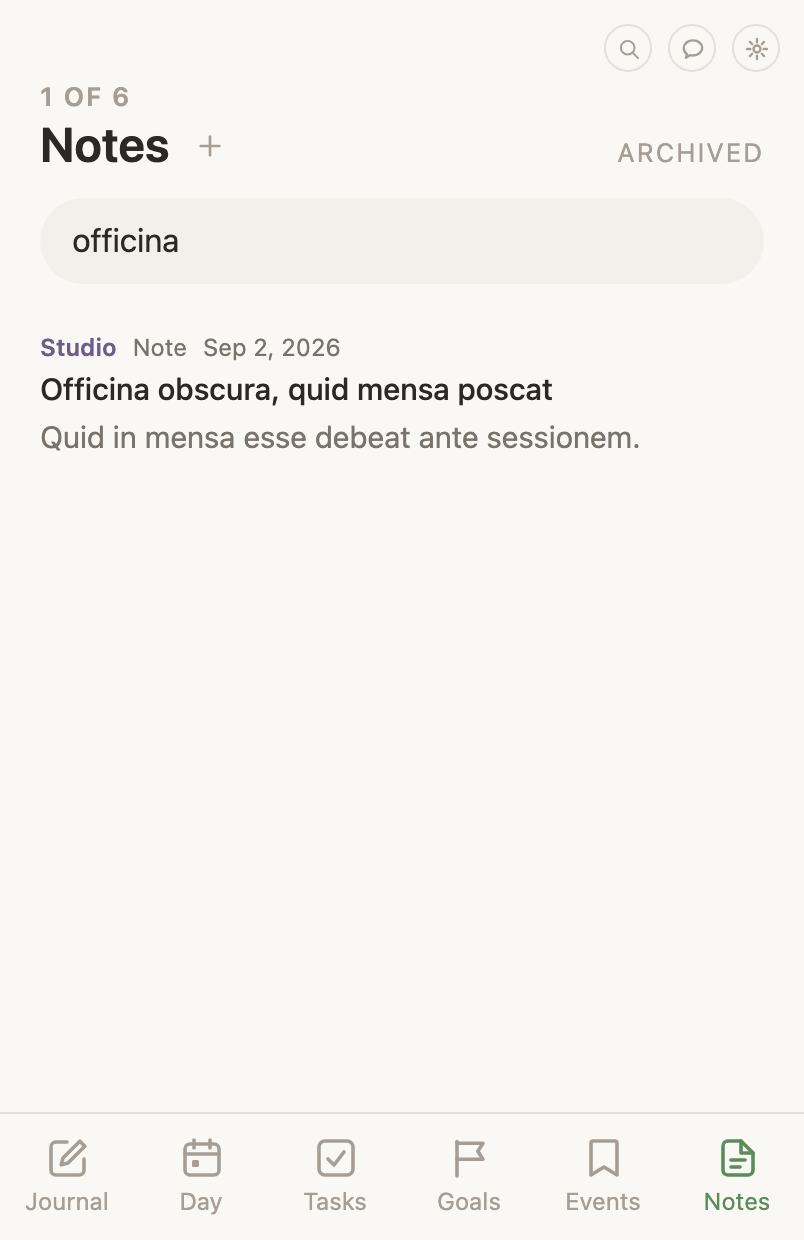
Finding oneThe list is the index, and the field searches it
Notes groups its rows by life area. Three words above the list — Areas, Type and Date — arrange the same notes three ways, and Areas opens first. Type sections the list by your own word for what a note is, and Date sections it by month, newest month first. A note you never filed under an area gathers under No area at the end of the Areas view, and one you never gave a type under No type at the end of Type. Every heading folds, and a folded heading stays folded until you open it again. On the phone a sideways swipe across the list moves between the three views as well, and in a browser the three words are the way across.
A row also says who wrote a note when it was not you. Yours are unmarked. One written by something else shows a word on its meta line, and again under its title when you open it: Claude for a Claude session working through the connector, Assistant for the chat inside the app, Unattributed for a write that named nobody. Notes made before the app started keeping this show nothing, so an unmarked row from that time is not a claim that you wrote it.
A row reads the life area it is filed under, your word for its type, its date, and the goal it is under where it has one, then its title and its description. Under Areas and Type a row drops whichever of those the heading above it has already said. Under Date a row keeps its own full date, since the heading names the month alone. Inside a section the newest date leads. A note with no date of its own takes the day of its last edit, and a new one starts stamped with today, so renaming a note does not move its row and neither does typing inside one.
The search field, rather than the top of the list, is the way back to the one you were writing in last week. The field searches as you type, and the grouping goes away while it has words in it: the list becomes one run of hits with a count above it. It matches the title, the description, the type, the goal a note is filed under and the life area, and it reads the text inside your notes as well, on the web and on the phone alike. A month later you remember a sentence you wrote far more often than the title you gave it.
If the server cannot search inside your notes right now, a line under the field says so, and the field keeps matching the rows.
The list exists so nothing gets lost. If you delete the journal entry that pointed at a note, the note is still here. Without this list you would have no way back to it.
Reading and editingThe same editor on the web and on your phone
Opening a note shows the whole thing, with its headings, lists and checkboxes as you wrote them, on the web and on the phone alike. On the web, Rename is one of the words along the top and tapping the title does the same thing. On the phone, Rename is under the ⋯ at the top.
Under the title is the life area the note belongs to, in that area’s colour, on the web and on the phone alike. Tap it and your areas come up, filtered as you type; pick one and the note is filed there. Picking No area at the bottom of the list takes it back off, and it stays off. With AI on, a note you have not filed yourself gets filed for you within a few minutes, on both, and your own pick always replaces that.
A note has no event of its own. Your events hold notes, so you file one from the event rather than from the note. New note at the foot of an event’s notes list starts a note already filed under it, and Events says how. A note filed that way is listed under Notes on the event’s own page, where its title opens it, and it reaches an event only when you put it there. The web and the phone read the same way.
On the web, every note is fully editable, formatting included, and saves itself moments after you pause. If edits failed to save before you left the page, the note says so the next time you open it, so a lost save never looks stored.
The phone runs the same editor, so it writes the same things: headings, bulleted and numbered lists, checkboxes, quotes, code, links, tables, bold, italic, strikethrough, text colour and highlight. A bar above the keyboard holds them, and it shows what the line your cursor is on already is. Typing - starts a bullet and ## starts a heading, the same shortcuts the web takes.
Photographs go in too. On the web, drop one into the note or pick it from the editor's own menu. On the phone, the ▣ button on the bar adds one from your camera roll, and holding it opens the camera. A photo that did not upload says so on the bar rather than quietly doing nothing.
The phone saves itself on the same clock as the web, and says Unsaved, Saving or Saved next to the note while it does. There is nothing to press and nothing to lose by leaving.
History at the top of an open note reads back what it said before. On the phone it is under the ⋯. Every save is kept, and the panel gathers a long afternoon of them into one sitting rather than listing forty. Save version marks the text as it stands and lets you name it, opening one shows how the note read then, and restoring puts it back, keeping what the note says now as a version first.
Your Journal gets no entry about an editing session. The changes save into the note as you write, and the note itself is the record.
Turning one into a goalA note can become the goal it turned out to be
Writing often starts as a note and turns out to be a goal. Make this a goal moves it across without retyping a word. On the web it is along the top of an open note and in the row menu on the list, and it asks before it goes. On the phone it is under the ⋯ at the top of an open note, where it goes straight away, and on a press and hold on a row, where it asks first. The row leaves the list when the move lands, so a row menu asks on both.
The goal takes the note’s title as its name, its life area, and every word of its text. The note itself is archived rather than deleted, so it is still under Archived if the move was wrong. From that moment the two texts are separate. Editing the goal leaves the archived note as it was, and the other way round.
The web lands you on the new goal. The phone closes the note and the list says which goal it became, with a button that opens it.
A note with no title cannot make a goal, since a goal needs a name, and the app says so rather than naming one for you. A title that matches a goal you already have is refused for the same reason.
Putting one awayArchive keeps it, delete means gone
Archive takes a note out of the list without destroying the writing. On the web, right-click a row (press and hold on a touch screen) for Rename, Make this a goal, Archive and Delete permanently. An open note reads Rename, History, Make this a goal, Archive and Delete permanently along its top. On the phone, a press and hold on a row opens the same four, and an open note holds all five under the ⋯ at the top.
Archived notes stay reachable through the Archived link at the top of the list, where the same menu reads Restore and puts one back. Notes in the same place is the way back to the live list. The phone puts the same word in the same place, beside the heading.
Delete permanently is the one action that asks first. The note and its text are gone for good. A journal entry that pointed at the deleted note keeps its writing and simply stops being a note.